The Huntington is presenting the first regional production of Aaron Sorkin’s take on Harper Lee’s “To Kill a Mockingbird,” with performances continuing through Nov. 8. Directed by artistic director Loretta Greco, the staging has received favorable assessments from WBUR and 1 Minute Critic, which both highlighted its ensemble and emotionally demanding courtroom scenes.
The production follows the play’s Broadway, touring and West End engagements, according to 1 Minute Critic. Karl Kenzler plays Atticus Finch, the Alabama lawyer defending Tom Robinson, portrayed by Rafael Jordan. Their story anchors a production that places questions about racism, justice and personal responsibility alongside the childhood experiences familiar to readers of Lee’s novel.
Although the two reviews emphasize different aspects of the staging, neither offers an overall negative assessment. WBUR’s Jacquinn Sinclair focuses on the emotional force of the performances and the tension between Atticus’ faith in others and the hostility surrounding him. At 1 Minute Critic, Jerry Portwood emphasizes how the play preserves the central story while broadening its moral perspective.
A familiar story, with a shifted focus
Sorkin gives more attention to Calpurnia, the Finch household’s longtime employee, played by Patrice Jean-Baptiste. Both reviewers single out her performance and describe a character who challenges Atticus rather than simply supporting him. Her exchanges with the lawyer expose the limits of his optimism about the law and his neighbors.
The younger characters remain central to the storytelling. Karen Killeen plays Scout, Benjamin Izaak plays her brother Jem, and Andrew Stevens Purdy appears as their friend Dill. Portwood notes that their childhood adventures occupy less space in this version, which concentrates more heavily on the trial. Sinclair describes action moving between the courtroom and the Finch home.
Both critics also draw attention to Jackie Scholl’s portrayal of Mayella Ewell, whose accusation brings Robinson to court. Sinclair describes a performance that stills the audience, while Portwood emphasizes its combination of anger, fear and vulnerability. Their accounts identify the testimony as one of the production’s most unsettling passages.
Music and scenery shape the production
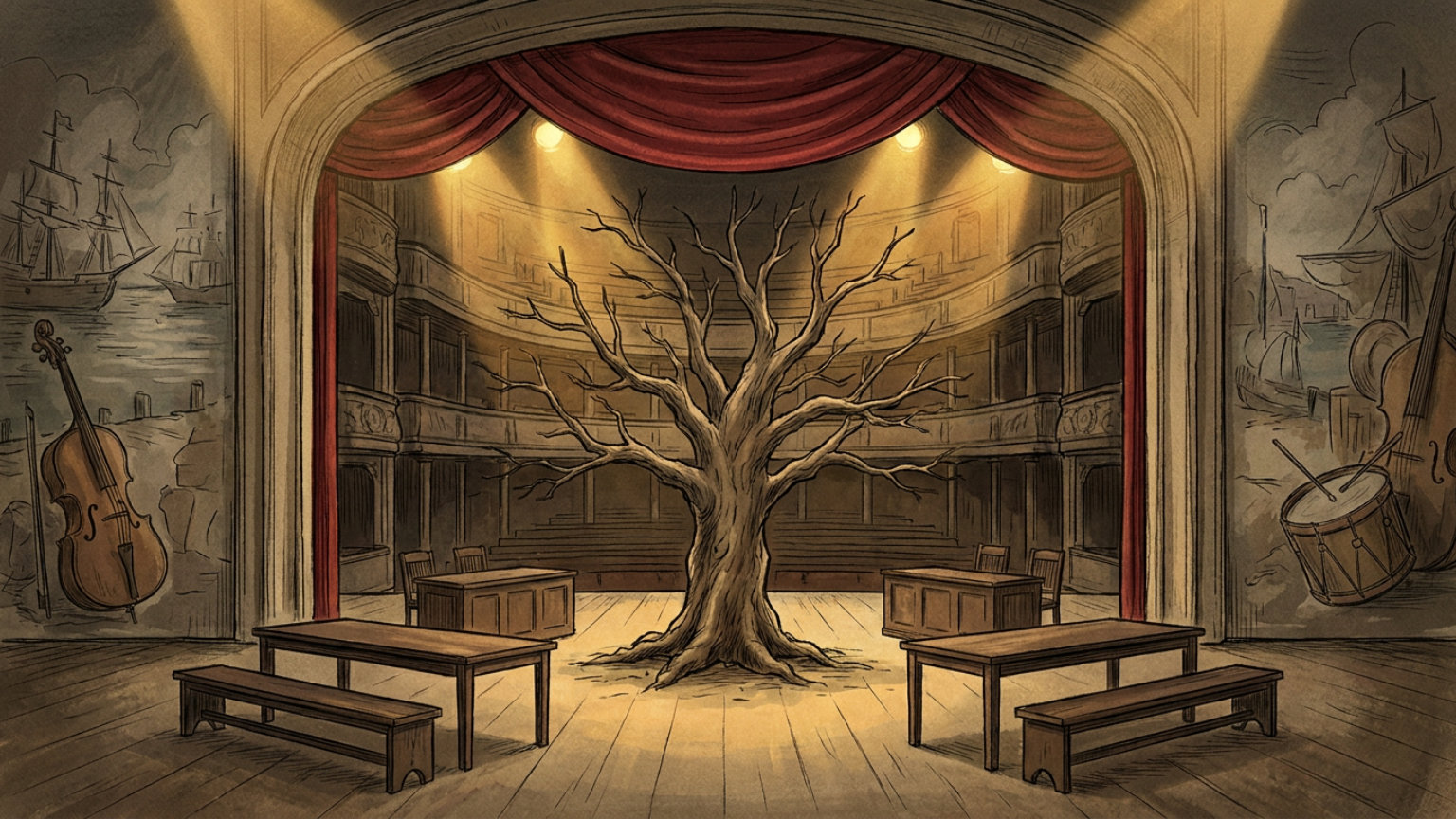
A large tree dominates the stage, linking the children’s surroundings to the story’s darker themes. Portwood credits scenic designer Andrew Boyce with an oak that reaches almost 40 feet upward. Sinclair’s account begins with Scout playing beneath its branches, an opening whose apparent calm contrasts with what follows.
Ashley Frith supplies live music onstage, another element noted by both outlets. Portwood identifies Frith as a musician and co-composer and describes the music as an effective accompaniment that does not overwhelm the action. Sinclair also notes that Sorkin’s humor offers moments of relief amid the story’s brutality.
The reviews ultimately locate the production’s impact in the friction between lessons about kindness and the realities of racial injustice. For Boston audiences, the Huntington run offers an opportunity to see how those tensions translate from Lee’s novel into Sorkin’s courtroom-centered theater.