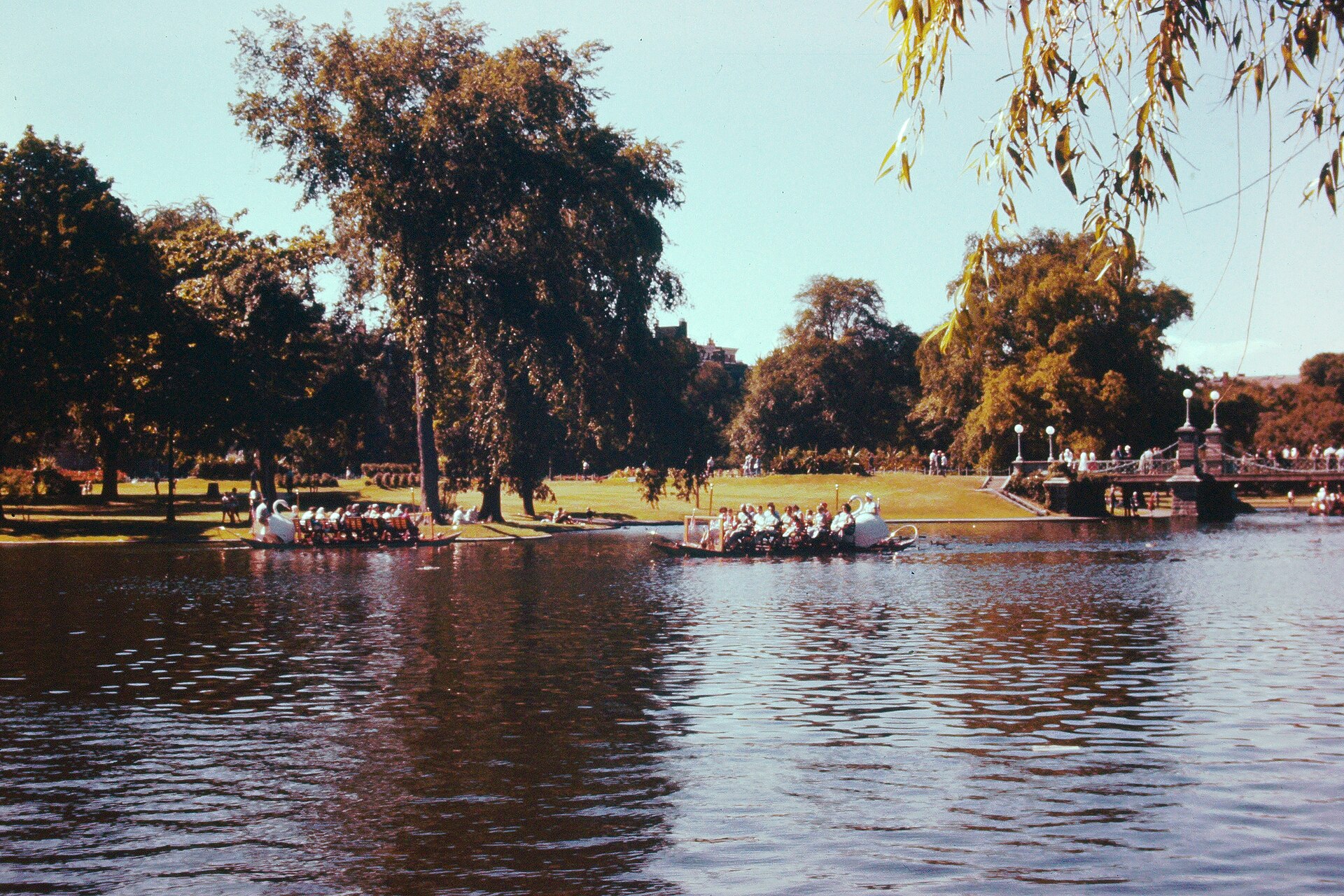
BOSTON — The Swan Boats have carried passengers around the Public Garden lagoon since 1877, remaining a Paget family enterprise through four generations. Their distinctive design began with a practical problem: how to conceal the machinery that powered a boat while providing a place for its operator.
Robert Paget’s answer was a swan-shaped enclosure. According to the business’s published history, his descendants still manage the operation, with fourth-generation family members Lyn and Phil carrying on a tradition that began when Boston licensed Robert to rent boats in the 1870s.
The setting itself reflects an earlier transformation of Boston. The Public Garden occupies former tidal marshland between Beacon Hill and Back Bay, beside Boston Common. Established in 1837, it became the country’s first public botanical garden, according to the garden’s historical account on Wikipedia. Its pond was completed in 1859, well before the Swan Boats arrived.
Small rowboats initially gave residents a way to enjoy the lagoon during summer days and evenings. In 1877, Paget introduced a different vessel: a two-pontoon craft with passenger benches ahead of the operator. A bicycle-like pedal mechanism drove a paddle wheel, while the swan form surrounded the captain and covered the equipment, the company history says.
The design also drew on the interests of Robert and Julia Paget, who enjoyed opera. Their inspiration came from Richard Wagner’s “Lohengrin,” whose story includes a knight traveling across a river in a vessel pulled by a swan. On the lagoon, that theatrical image became the defining feature of a passenger boat.
A business carried through generations
Julia subsequently took full responsibility for the enterprise, managing it for more than three decades while raising four children. The company’s account describes an unusual hurdle for a woman running a business at that time: for years, she had to collect endorsements from Back Bay business owners. Her tenure began before women gained voting rights.
The next family transition came in 1914. John, the youngest of Julia’s children, took over alongside his wife, Ella. As demand for rides grew, the vessels were enlarged to carry 20 passengers on five benches. Rowboats continued sharing the lagoon with the Swan Boats until the middle of the 1940s.
All six of John and Ella’s children worked summer seasons on the boats. Their son Paul took responsibility for the operation with his wife, Marilyn, in 1952; the couple remained in charge for more than half a century. Their daughter Lyn now manages the business with her cousin Phil, according to the family history. The company lists six boats in its fleet, including one built in 1910.
The boats also acquired a place in children’s literature. Robert McCloskey included them in “Make Way for Ducklings,” about mallards raising ducklings in the Public Garden. In E. B. White’s “The Trumpet of the Swan,” Louis performs on his trumpet for Swan Boat passengers. Both books connect the family’s lagoon business to stories set in Boston.