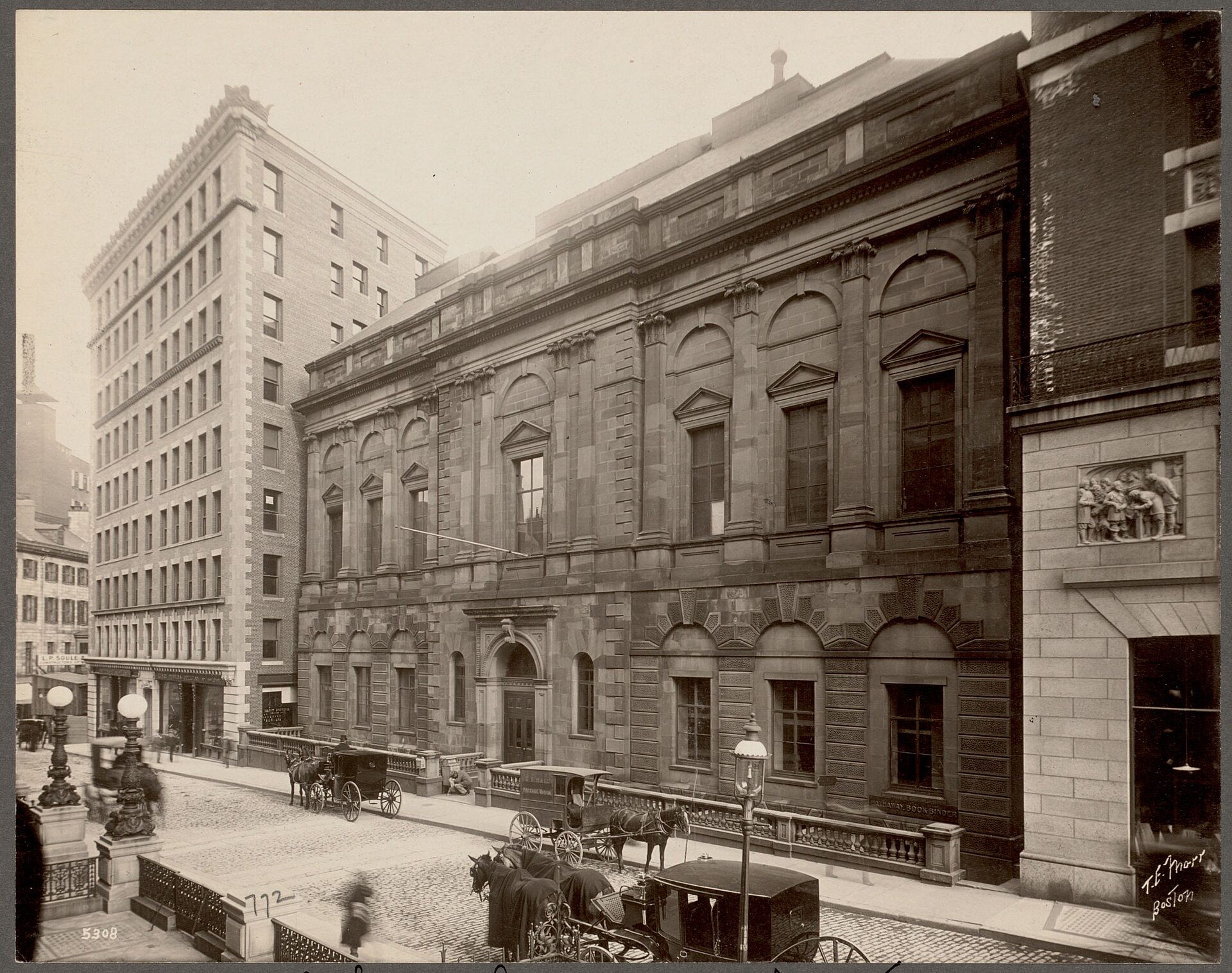
BOSTON — At 10½ Beacon St., the Boston Athenaeum combines a lending library, art collections and cultural programming in an institution whose roots reach back to 1807. Among the oldest independent libraries in the country, the Beacon Hill nonprofit remains supported by members rather than operating as a public library.
Its circulating holdings exceed 500,000 books, ranging from 19th-century publications to current bestsellers, according to the Athenaeum. The institution also reports research collections containing 100,000 rare books, manuscripts and maps, along with 100,000 artworks. Its programs include exhibitions, concerts, author appearances and book clubs.
For Boston readers, the Athenaeum offers both a collection to explore and a record of the city’s cultural development. Its research strengths include Boston, local and state history across New England, and fine arts. Five floors of galleries, books and reading spaces look toward the Granary Burying Ground.
From a magazine to a library
The institution emerged from the Anthology Society, a group organized in 1805 whose members published a literary magazine. Their initial idea for a reading room grew into a broader undertaking: a library with books across subjects and languages, accompanied by art and other collections.
Early membership worked differently from borrowing privileges today. Annual subscriptions initially cost $10, and members could bring guests into the rooms. But the books stayed inside: The original collection did not circulate. Efforts to allow borrowing began in 1830, according to the institution’s history summarized by Wikipedia.
The Athenaeum changed addresses several times before settling on Beacon Hill. Its early quarters included Congress and Tremont streets. In 1809, it relocated to a house beside the King’s Chapel burial ground, then moved to a Pearl Street mansion in 1822.
Art became an established part of its work during those years. A gallery opened in 1827, and annual exhibitions presented work from America and Europe. The mix of reading, research and visual art would shape the institution’s next home.
A building shaped around its collections
Work on the Beacon Street building began in 1847. Architect Edward Clarke Cabot designed the structure, which opened in 1849 with sculpture at ground level, books one floor above and paintings on the skylit third floor.
The building subsequently expanded as the institution evolved. A renovation designed by Henry Forbes Bigelow added two upper floors in 1913-14. National Historic Landmark designation followed in 1965.
Another renovation, undertaken from 1999 through 2002, extended climate control throughout the building and incorporated space at neighboring 14 Beacon St. In 2022, Ann Beha of Annum Architects designed further improvements to the historic property and an expansion into an adjoining building, according to the Athenaeum.
The holdings connect that architectural history to a much wider world. They include a substantial share of George Washington’s Mount Vernon library, an Audubon first edition and portraits by artists including John Singer Sargent. Readers associated with the institution have included Louisa May Alcott, Margaret Fuller and Nathaniel Hawthorne.
Today, the Athenaeum says membership is open to everyone. Alongside its subscription-based library services, a public gallery and cultural events continue the combination of books, art and discussion that guided its founders more than two centuries ago.